5 Things Quietly Costing You Business on Your Website

Most business owners blame marketing when leads dry up, but the real issue is often architectural flaws on their website. From slow mobile load speeds and vague hero headlines to broken tracking and self-centric messaging, these technical bottlenecks actively leak high-intent visitors. Discover the five crucial website fixes that transform passive traffic into predictable revenue.

7–10 minutes
1,631 words

Most business owners assume a slow month is a marketing or ad spend problem. More ads, more posts, more cold emails. However, after auditing dozens of digital platforms, the issue is almost always simpler: your website is actively leaking high-intent visitors before they ever reach your offer.

Below is an exhaustive diagnostic breakdown of the 5 architectural flaws costing you business daily, along with the technical engineering fixes to turn your site into a high-performance sales engine.
High-Speed Digital Architecture Isn’t an Accident

When high-growth companies outpace their sector, casual observers attribute their success to marketing buzz or raw ad spend volume. That assumption sounds counterintuitive until you analyze the technical infrastructure beneath top-converting digital properties. While standard companies build bloated websites focused on decorative design trends and heavy legacy frameworks, high-performing operators engineer lean, frictionless platforms optimized for instantaneous interaction.

They recognize that the biggest barrier to customer acquisition isn’t lack of market awareness—it is the subtle friction embedded in slow page rendering, obscure value propositions, and broken data architectures. By treating their website as a precision engineering asset rather than a static digital brochure, they transform cold traffic into a predictable, automated client acquisition engine.
KEY TAKEAWAYS
Sub-3-Second Mobile Latency: If your mobile page latency exceeds 2.8 seconds, bounce rates surge past 50% before prospects ever read your headline or understand your offer.
Frictionless Viewport Positioning: Decision-makers judge your authority within five seconds; having a single, high-contrast CTA above the fold eliminates cognitive drop-off.
Full Data & Consent Compliance: Operating without Google Consent Mode v2 and custom event tracking breaks ad optimization algorithms and inflates client acquisition costs.
Metric-Backed Case Studies: Replacing static portfolio galleries with quantitative, problem-intervention-result case studies directly multiplies high-ticket retainer close rates.

1. Sub-Optimal Load Latency and Mobile Layout Instability

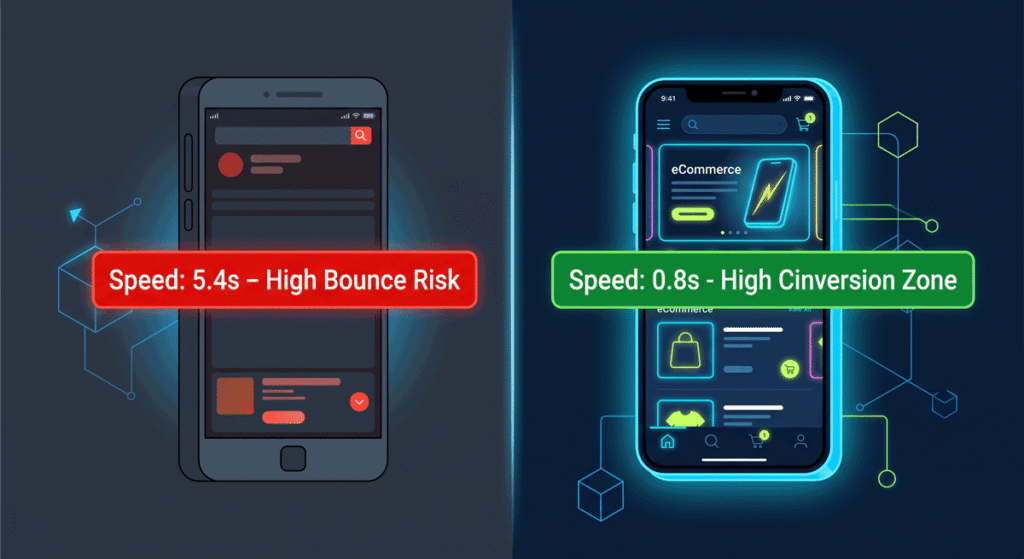
Modern consumers and business decision-makers operate with zero patience for sluggish web assets. Comprehensive performance studies confirming millions of commercial user sessions reveal that when page rendering exceeds 2.8 seconds, bounce rates accelerate exponentially. On mobile devices—which now generate over 60% of total commercial web traffic—latency is compounded by uncompressed high-resolution images, render-blocking JavaScript bundles, and legacy theme frameworks.

Beyond raw loading speed, layout instability (measured by Cumulative Layout Shift or CLS) creates intense user frustration. When dynamic banner elements, un-dimensioned imagery, or late-executing third-party scripts pop into the viewpoint and shove content downward while a visitor is attempting to click, trust evaporates immediately. It signals technical carelessness before a prospect has read a single sentence of your offer.
Split screen graphic. Left side: A dark, sluggish smartphone screen showing a loading spinner with red diagnostic overlays reading 'Speed: 5.4s - High Bounce Risk'. Right side: A sleek, ultra-fast UI rendering instantly on a smartphone screen with green diagnostics reading 'Speed: 0.8s - High Conversion Zone'. Professional vector style, dark background, blue and neon accents

🛠️ Technical Fix & Engineering Standard:

Media Format Modernization: Convert all legacy JPEG and PNG assets into modern WebP or AVIF formats. Implement responsive image srcset attributes so mobile viewports never download desktop-resolution assets.
JavaScript Deferral: Defer non-critical third-party scripts (chat widgets, remarketing tags) until after primary DOM content render. Clean out unused plugins and minify stylesheet bundles.
Edge-Level Caching: Deploy server-side object caching (Redis/Memcached) paired with an edge Content Delivery Network (Cloudflare) to bring Time-To-First-Byte (TTFB) below 1.0 second globally.

2. Obscured Value Proposition and Ambiguous Hero CTAs

When a prospective client lands on your homepage, you have precisely five seconds to communicate three foundational answers: What specific problem do you solve? Who do you solve it for? What exact action should I take right now?

The overwhelming majority of small and mid-sized business websites fail this fundamental test. Instead of leading with a sharp, outcome-driven value proposition, hero banners are cluttered with vague corporate jargon (“Innovating tomorrow’s strategic synergies”) or decorated with slow background videos that add zero clarity. Compounding this issue is the presence of multiple competing buttons above the fold, forcing visitors to evaluate choices rather than taking action. When cognitive friction increases, visitors bounce.

🛠️ Technical Fix & Engineering Standard:

H1 Outcome Clarity: Re-engineer your primary H1 heading to explicitly state the quantifiable transformation your business delivers (e.g., “We Build High-Converting Web Platforms for Growing B2B Brands”).
Isolate the Primary Action: Display a single, high-contrast CTA button above the fold (e.g., “Request a Free Technical Audit” or “Book a Strategy Call”). Move secondary actions into sub-sections or remove them entirely.
Immediate Social Proof Anchoring: Embed verified client logos, industry certifications, or review metrics directly beneath the main hero CTA within the initial viewport height.

“”Clarity always beats cleverness. If a prospect has to hunt through navigation menus or decode corporate jargon just to figure out how to buy from you, your conversion rate is already zero.”

— Primus Media Online

3. Fragmented Analytics, Tag Architectures & Non-Compliance

Attempting to scale client acquisition without a clean, compliant tracking infrastructure is mathematically equivalent to flying blindfolded. In practice, an alarming number of company websites operate with duplicated tracking scripts, untracked conversion forms, or broken analytics setups that attribute paid traffic incorrectly.

Furthermore, operating in modern markets without compliant consent frameworks (such as Google Consent Mode v2) means advertising networks like Google Ads, Meta, and LinkedIn are legally blocked from modeling unconsented conversions. This breaks attribution algorithms, prevents machine learning models from optimizing for high-intent users, inflates cost-per-lead, and corrupts retargeting audiences.

🛠️ Technical Fix & Engineering Standard:

Unified Container Hygiene: Consolidate all disparate pixels (LinkedIn Insight Tag, Google Analytics 4, Meta Pixel) inside a single Google Tag Manager (GTM) container to eliminate render-blocking script collisions.
Custom Event Mapping: Build custom GTM triggers for micro-conversions: form field engagement depth, video view percentages, calendar booking submissions, and direct contact clicks.
Consent Mode v2 Deployment: Implement an authorized Consent Management Platform (CMP) synchronized with GTM triggers to ensure regulatory compliance while enabling machine learning conversion recovery.
< 1.0s
Target Edge Latency
Eliminates the 50%+ bounce rate caused by un-optimized media assets and legacy server latency.
+140%
Avg. Conversion Lift
Generated by aligning primary viewport CTAs, clear value propositions, and mobile UX flow.
100%
Consent Mode v2
Guarantees complete legal compliance while preserving ad algorithm conversion modeling.
3.2x
Retainer Close Velocity
Achieved by shifting from static portfolio screenshot galleries to diagnostic case studies.

4. Self-Centric Copywriting vs. Pain-Point Positioning

A primary barrier preventing ambitious service businesses from closing premium retainers is self-centric copywriting. Websites filled with company-focused statements—such as “We are an innovative agency,” “Founded in 2018,” or generic bulleted lists of technical deliverables—completely fail to connect with what prospects care about.

High-intent buyers do not evaluate your history or service taxonomy in a vacuum; they care about their immediate operational bottlenecks and the financial return of solving them. When landing pages fail to diagnose the prospect’s pain point before presenting the solution, visitors perceive the offer as a commoditized expense rather than an indispensable investment.

🛠️ Technical Fix & Engineering Standard:

Deploy the PAS Framework: Structure service copy using Problem → Agitation → Solution. Define the client’s current operational bottleneck, highlight the financial cost of inaction, and present your framework as the direct resolution
Dedicated Campaign Landing Pages: Stop driving paid or organic campaign traffic to your broad homepage. Build dedicated, single-objective landing pages tailored specifically to the traffic source and audience intent.

5. Static Portfolio Grids Lacking Diagnostic Depth

Presenting a basic visual grid of client screenshots with external links is no longer sufficient to close high-value B2B retainers. Serious clients do not evaluate partners purely on visual aesthetics—they evaluate strategic problem-solving competence, execution velocity, and quantifiable business outcomes.

A portfolio that shows what a website looks like without explaining what it accomplished fails to prove domain authority. Demonstrating that an interface redesign decreased page load latency from 4.8 seconds to 0.7 seconds and lifted conversion volume by 120% is what justifies premium retainers and builds immediate prospect trust.

🛠️ Technical Fix & Engineering Standard:

The 3-Part Case Study Architecture: Format every portfolio item into three disciplined sections: 1. The Initial Technical Bottleneck, 2. The Strategic & Code Intervention, 3. The Measurable Business Outcome
Quantitative Performance Badges: Include verified before-and-after performance metrics—Google Lighthouse scores, conversion rate percentage gains, and cost-per-acquisition reductions—alongside visual UI transformations.

What Primus Media Would Do Differently

Most agencies treat website development as an isolated graphic design exercise. At Primus Media, we treat digital architecture as an integrated, revenue-generating engine built to support continuous business expansion.
Speed-First Frontend Architecture: Clean, semantic codebases built without bloated multipurpose themes or unneeded legacy plugins.
Full-Funnel Tracking Systems: Google Tag Manager setups with custom JavaScript triggers and offline conversion routing.
Conversion-Engineered UX: Strategic eye-tracking visual hierarchy, high-contrast CTAs, and mobile-first navigation flows.
Outcome-Driven Messaging: Direct, pain-point-focused sales copy that frames your services around measurable business returns.
The Conversion Mandate
Traffic is expensive; conversions provide leverage. Systematically resolving the structural and technical bottlenecks in your digital foundation before scaling ad budgets is the highest-ROI investment your business can make.

The Technical Standard for Modern Websites

The single biggest operational insight for modern businesses is that a website is never truly ‘finished’—it is an evolving technical instrument. In a marketplace saturated with generic content and identical templates, technical execution and frictionless usability are significant competitive advantages.

Top-performing organizations don’t rely on bloated, off-the-shelf page builders. They audit their site latency relentlessly, optimize asset pipelines, configure conversion tags with surgical precision, and design every single viewport with a clear, unambiguous user trajectory.
Native Speed Baseline: Does your mobile page load in under 1.5 seconds on standard 4G mobile connections without layout shift?
Hero Friction Audit: Can a first-time visitor understand your offer and spot your primary action within 5 seconds of rendering?
Attribution Integrity: Are your Google Tag Manager triggers and Consent Mode v2 implementations firing without duplicate tags or dropped events?
Diagnostic Proof: Does your case study presentation prove quantifiable ROI, or does it merely display decorative screenshots?
”Final thought“
“A corporate website is not an online business card—it is your primary 24/7 sales representative. When engineered with speed, clear positioning, and robust analytics, it consistently out-converts any generic competitor in your market.”

Ready to Identify What’s Blocking Your Website’s Growth?

Stop losing high-value prospects to hidden conversion bottlenecks. Get a comprehensive technical and structural audit of your digital platform.

Expert insights, delivered!

Stay informed with the latest updates and exclusive resources for high-growth teams. Reinforces professional authority and the "Trusted by teams" badge.